
Why pharmaceutical glass container integrity matters for drug safety & efficacy
Chemical stability of pharmaceutical glass for drug safety, efficacy & shelf life

Glass has been used for medicinal storage since the 1st century BC, but its systematic use for pharmaceutical storage began in the early 17th century and became firmly established from the 18th century. While polymer containers are used in certain specialized applications, glass remains the most widely used and preferred material for pharmaceutical packaging. This is due to its worldwide availability, strong barrier properties against moisture and oxygen, chemical stability, and good compatibility with a number of sterilization methods.
On average, 75 injectable drugs, including biologics, small molecules, vaccines, and biosimilars, are launched to the market every year [1]. While these drugs may differ in molecular structure and function, they share an important challenge: to maintain chemical stability over their entire shelf life. This is defined as “a substance’s capacity to maintain the predetermined levels of identity, potency, and purity” [2].
If chemical stability is not ensured, leachables may be released from the surface of the glass container. Defined as “substances that migrate into a pharmaceutical formulation under normal preparation and storage conditions” [3], leachables are usually a subgroup of extractables. For instance, a substance in a drug formulation can react with a constituent of the packaging and form an entirely new compound. This would be identified in a leachable study but not in an extractable study.
Leachables can lead to:
- pH shift – defined as a change in the acidity of the solution (usually an increase in the pH of the drug) due to alkali metals leaching out of the glass.
- Drug inactivation – refers to the degradation or denaturing of the active drug compound caused by substances leached from the container.
- Aggregation - this can occur in one of two ways:
- Precipitation
The leaching of different elements from the glass, such as sodium, calcium, boron, or silica, in the solution (especially chemically aggressive ones with high pH) can lead to the precipitation of particles when the solubility limit of a specific leachable is reached. These precipitates are usually deposited at the bottom of the container. - Generation of insoluble particles
One example of this phenomenon is glass delamination, which the FDA describes as “the potential for glass under certain conditions to shed thin, flexible fragments called glass lamellae” [4]. Glass delamination is the result of a specific interaction between the drug and the inner surface of the glass container [5]. Occurring mainly in vials, this is one of the most critical failure scenarios for pharmaceutical companies.
- Precipitation
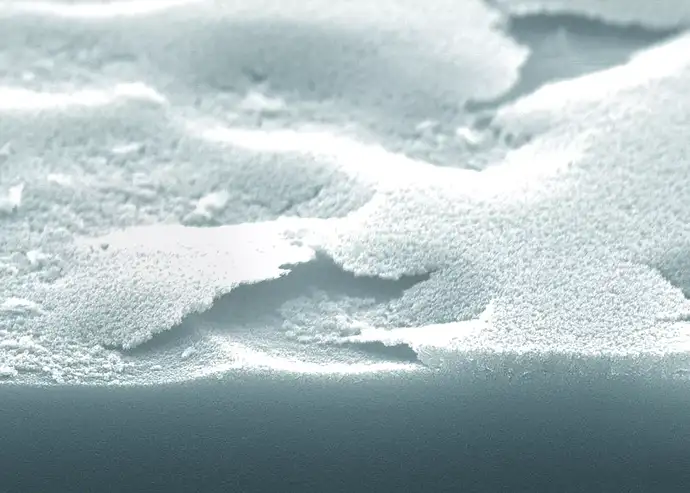
Inner glass surface of a highly corroded borosilicate glass container (SEM image with a magnification factor of 100,000)
Choosing the right glass composition
The chemical stability of pharmaceutical glass depends on two factors: the raw glass composition and the converting process of the tubing into the primary container. According to Ph. Eur. Chapter 3.2.1 “Glass containers for pharmaceutical use” and USP <660>, containers are classified as Type I, Type II, or Type III depending on their hydrolytic resistance.
- Type I glass containers
Made of borosilicate glass, these glass containers for pharmaceutical use are formed by significant amounts of boric oxide, as well as aluminum oxide, alkali metal oxides, and/or alkaline earth oxides. Due to its composition, this neutral glass has high hydrolytic resistance and thermal shock resistance. Type I glass containers are suitable for most preparations and parenteral administration. - Type II glass containers
This type of pharmaceutical glass contains alkali metal oxides (mainly sodium oxide) and alkaline earth oxides (mainly calcium oxide). Type II glass has a medium level of hydrolytic resistance thanks to its inner surface treatment, so is suitable for the parenteral administration of the majority of acidic and neutral aqueous preparations. - Type III glass containers
Produced with soda-lime-silica glass with a lower hydrolytic resistance. Type III glass containers are generally suitable for non-aqueous or powder preparations for both parenteral and non- parenteral administration.
| Glass type | Composition | Hydrolytic resistance | Suitable for |
|---|---|---|---|
| Type I | Significant amounts of boric oxide, as well as aluminum oxide, alkali metal oxides, and/or alkaline earth oxides | Highest | Most types of preparation, either parental or non-parental |
| Type II | Contains alkali metal oxides (mainly sodium oxide) and alkaline earth oxides (mainly calcium oxide) | Medium | Most acidic and neutral, aqueous preparations, for both parenteral and non-parenteral administration |
| Type III | Contains alkali metal oxides (mainly sodium oxide) and alkaline earth oxides (mainly calcium oxide) | Moderate | Non-aqueous or powder preparations for parenteral and non- parenteral preparations |
How the manufacturing process influences the chemical stability of pharmaceutical glass
The glass converting process has a significant impact on the chemical stability of the final container. Tubular containers are formed by two processes: the first produces the tube itself using the tube drawing process, while the second converts this tube into the final container.
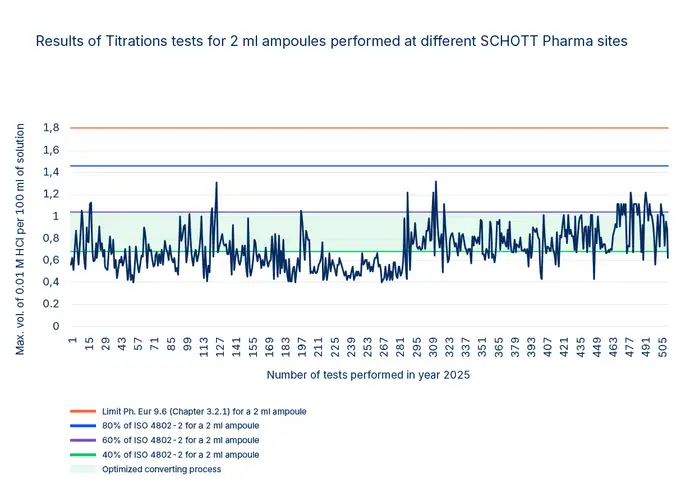
Controlling the converting process, especially the temperatures needed to form the bottom, heel, shoulder, and neck areas, is crucial to maintaining the chemical stability of the inner surface. Poorly controlled converting may cause an excessive evaporation of glass components, lowering the final chemical resistance.
SCHOTT Pharma has more than 100 years of experience in producing world-leading glass ampoules, with a team that continuously advances its expertise to meet the highest quality standards.
Since we understand how important chemical stability is for our customers, we ensure full compliance with international regulations. Our global production network achieves hydrolytic resistance values up to 40% below the prescribed limits of ISO 4802, Ph.Eur. and USP standards. This offers enhanced protection for your drug product.
Offering outstanding levels of dimensional and cosmetic quality, SCHOTT Pharma Ampoules run efficiently on fill-and-finish lines, helping to safeguard patient health all the way to the point of use.
For us, “Because human health matters” isn’t just a motto. It’s our mission. We work every day to help ensure your medicine reaches patients just as it should – safe, stable, and effective.
At a glance
- Glass remains the preferred pharmaceutical packaging material due to its barrier properties, chemical stability, sterilization compatibility, and global availability.
- Chemical stability is essential to maintain a drug’s identity, potency, and purity throughout its shelf life.
- Leachables released from glass containers can cause pH shifts, drug inactivation, precipitation, and glass delamination.
- Glass composition and the container converting process determine the final chemical resistance of pharmaceutical containers.
[1] IQVIA, “Global Trends in R&D 2023“ Report
[2] Wani, Rashime, “Chemical Stability of drugs” – Futuristic Trends in Pharmacy & Nursing, vol. 3, Book 18, Part 7, Chapter 1
[3] Canton, Haines & Sogding, “How Sterilization of Primary Packaging Influences the Results of E&L Studies”
[4] FDA, Advisory to drug manufacturers: Formation of glass lamellae in certain injectable drugs. Rockville, MD, Mar 2011. www.fda.gov/drugs/pharmaceutical-quality-resources/summary-recent-findings-related-glass-delamination
[5] Haines, Scheumann & Rothhaar, “Pre-testing stops a big problem before it even starts”, Contract Pharma (June 2013)
Topics
Get in touch

Victoria de la Torre