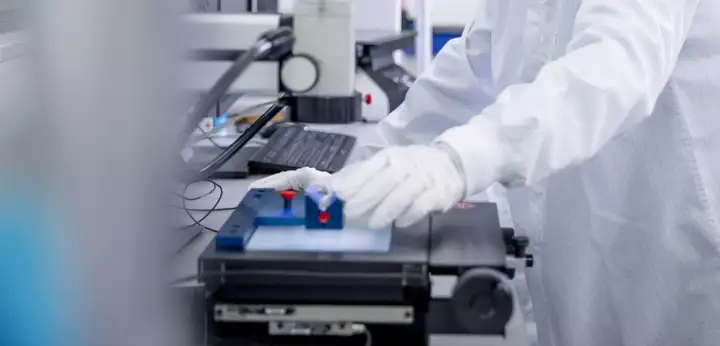
Laboratory technician operating equipment at a workstation in a cleanroom environment

USP <382> functional testing solutions

Unbiased, regulatory‑ready results for your fully assembled drug‑filled systems
PROBLEM STATEMENT

Why USP <382> compliance has become a critical bottleneck

Pharmaceutical companies must demonstrate the functional suitability of the elastomeric components used in parenteral packaging systems as defined by the USP <382> standard. However, executing these tests internally is often difficult, as selecting the correct test setup, ensuring regulatory conformity, coordinating multiple stakeholders, and operating specialized lab equipment can introduce significant risk, effort, and delays. Companies need a reliable, unbiased way to generate compliant data without burdening internal resources.
CHALLENGES

Common issues with USP <382> testing

USP <382> requires that functional testing is performed on the final-use configuration, which includes the complete container‑closure system filled with the actual drug product or a qualified proxy. This requirement significantly raises the technical and operational burden, and many laboratories are not equipped to handle drug products safely, cannot run tests with filled systems, or lack the controlled environments needed for compliant execution. These constraints will create critical gaps that slow down or even block the compliance process.


    usp-382_Text Image Slide-01

    Testing is complicated by final-use requirements

    USP <382> testing must be performed on the fully assembled, filled system, rather than empty or water-filled components. This increases the complexity of test selection and setup since the parameters may change significantly once the system contains a drug product or proxy. Many labs are not prepared to adapt their test designs to filled containers, leading to inaccurate or non‑compliant results.
    usp-382_Text Image Slide-02

    Limited lab capabilities for handling drug products or proxies

    The requirement to test the filled system demands special handling capabilities, including test environments, dedicated workflows, and safety measures for drug products or surrogates. Most laboratories lack these facilities, particularly when handling biologics or sensitive formulations, making USP <382> compliance either impractical or impossible.
    usp-382_Text Image Slide-03

    Operational bottlenecks due to drug-product handling

    Managing the logistics, safety protocols, and documentation for drug product test samples adds significant operational overheads. Many teams struggle to coordinate product shipment, storage conditions, stability timelines, and sample tracking, all of which are essential for USP <382> compliance.
    usp-382_Text Image Slide-04

    Rising expectations for unbiased, third‑party verification

    Since USP <382> testing is now more complex and more directly tied to regulatory filings, authorities increasingly expect independent, third‑party results. Internal labs often lack the independence, capabilities, or equipment required to produce credible data packages, making external support essential.
    THE SOLUTION

    SCHOTT Pharma’s integrated USP <382> testing service

    We provide an end‑to‑end third‑party testing service that covers the entire USP <382> workflow, from test plan creation to final report. Our FDA‑registered, ISO‑accredited laboratory, and experienced functional testing specialists ensure accurate, regulatory‑compliant results for elastomeric components and full container systems (syringes, vials, cartridges).

    Five testing requirements ensure that primary packaging materials maintain drug integrity and patient safety:

    1. Package integrity and CCI testing (USP <1207>): Ensures sterility protection and prevents contamination.
    2. Coring and fragmentation analysis (ISO 11608‑3, USP <788>, USP <381>): Minimizes particulate contamination risk.
    3. Penetration force, self‑sealing, and spike‑retention testing: Ensures ease of use and functionality, and confirms closure reliability post-penetration.
    4. Plunger functionality testing (ISO 11040‑4/-6/-8, ISO 21881, ISO 7886‑1): Break‑loose force, glide force, and plunger seal integrity testing to evaluate ease of drug administration and ensure leak-proof operation.
    5. Tip cap and needle shield removal force (ISO 11040‑4/-6/-8): Ensures usability and sterility preservation.

    USP <382> functional testing in action

    Explore how industry-standard elastomeric components in 3 ml ready-to-use cartridges perform under real-world conditions. Our whitepaper presents data-driven results from comprehensive USP <382>-aligned testing, including fragmentation, CCI, leakage, resealability, and break-loose force, referencing all relevant ISO standards.

    Whitepaper thumbnail: From fragmentation to break-loose force: A complete USP <382> assessment in parenteral delivery systems

    *Field is required

    To easily address any open topics, please feel free to provide your telephone number. We'll be happy to give you a call back.

    By submitting the form, you consent that we contact you via email providing you with further information on our solutions that fit your needs. We also connect your personal data to other information gathered from you to maximize your user experience and to help our customer service team interact with you in an efficient manner. For further details, including your possibilities to opt-out, please see our information on the SCHOTT Pharma Contact Profile

    ADVANTAGES

    Our comprehensive USP <382> testing services offer an end-to-end solution – handling the process from test selection to final documentation.


    Your simple path to compliance

    SCHOTT_Pharma_ICON_Number_1.svg
    We create a tailored test plan
    SCHOTT_Pharma_ICON_Number_2.svg
    You send us your drug product
    SCHOTT_Pharma_ICON_Number_3.svg
    We test the complete system
    SCHOTT_Pharma_ICON_Number_4.svg
    You receive a regulatory‑ready report
    This way, we eliminate bottlenecks, ensuring that your primary packaging meets regulatory expectations efficiently and reliably.
    SCHOTT_ICON_OnEx_About_Us_11_Application_Development.svg

    Drug-product handling

    Specialized workflows, dedicated test setups, and strict safety measures for handling drug products or proxies throughout the testing process.

    bluesky_icon_sdp_compendial_material_types.svg

    System‑level test expertise

    Evaluation of the full container‑closure system to deliver realistic performance data and enable root‑cause analysis across elastomer and glass/polymer components.

    SCHOTT-Glass-Carrier-Wafer-Icon-Quality_Mobile.svg

    Independent documentation

    Third‑party, objective results supported by structured documentation packages that meet the expectations of authorities and accelerate review processes.

    SCHOTT_Pharma_ICON_Develop_testing_2023.svg

    Reduced operational burden

    Streamlined end-to-end process, from tailored test planning to final reporting, reducing internal workload and minimizing cross‑functional coordination effort.
    RELATED PRODUCTS

    GET IN TOUCH

    Marius Römer

    Marius Römer

    Product Manager Services

    * Field is required

    SCHOTT Pharma will use your data only for reacting to your inquiry. Find more information about processing your personal data in SCHOTT Pharma’s data privacy policy


    I agree that SCHOTT Pharma AG & Co. KGaA may send me e-mails with information on products and services of SCHOTT Pharma. My data will not be passed on to third parties. After registration, I can revoke my consent at any time at the SCHOTT Subscription Center following the link in each email footer.